
What Probate Covers in Texas County
Probate is the court process for settling what a person owns and owes after death. In Texas County it runs through the Probate Division of the District Court, the same trial court that hears civil, criminal, and family cases. There is no separate probate court and no standalone probate court website. The judge handling an estate is the District Judge or the Associate District Judge, and the file itself sits with the Texas County Court Clerk. The Court Clerk lists probate as one of the divisions the office serves, alongside civil, criminal, juvenile, domestic relations, and small claims.
Probate covers far more than wills. The same division handles estates with or without a will, guardianships for minors and incapacitated adults, conservatorships and financial guardianships, trust proceedings, and the formal filing of a will for safekeeping. Each case builds a record as it moves through the court.
A probate file can hold a wide mix of documents. Common items include:
- Wills and orders admitting a will to probate
- Petitions to open an estate or appoint a guardian
- Letters testamentary or letters of administration
- Inventories and appraisals of estate property
- Creditor notices and filed claims
- Accountings and final decrees of distribution
Probate Terms Defined
Probate filings use words that rarely come up anywhere else. A few plain definitions make a Texas County estate docket much easier to read.
- Testator
- A person who makes a valid will. A will-maker who dies leaves what the court calls a testate estate.
- Executor
- The person named in a will to carry out its terms, gather assets, pay debts, and distribute property. Oklahoma filings often call this role the personal representative.
- Intestate
- Dying without a valid will. State law then decides who inherits, and the court appoints an administrator to handle the estate.
- Guardianship
- A court arrangement that gives one person legal authority over the care of a minor or an incapacitated adult.
- Conservatorship
- A court arrangement focused on managing the money and property of someone who cannot handle their own finances.
How to Search Texas County Probate Records
Oklahoma puts most district court dockets online through two free systems. On Demand Court Records, known as ODCR, is the system Texas County links to as its district court records source. The Oklahoma State Courts Network, or OSCN, also lists Texas County District Court in its statewide docket search. Either one can confirm whether a probate case exists, who the parties are, and what has been filed.
Online dockets do not hold every document. Wills, signed orders, and certified copies often stay in the paper or imaged file at the courthouse. Older estates and recently opened cases may not show online at all. When a search returns nothing, that does not prove no case exists.
- Pick the system. Open ODCR or OSCN and select Texas County District Court.
- Search by the name of the person whose estate is involved. Enter the decedent, the ward, the personal representative, or another party in last-name-first format.
- Filter by case type. Choose Probate Proceedings, Probate Miscellaneous, Guardianships, Conservatorship, Filing of Wills, or Trust Proceedings to narrow the results.
- Use the case number if you have it. Probate cases carry a PB or PROB prefix, and guardianships often carry a PG prefix, followed by the year and a number.
- Open the docket and read the entries. Filing dates, hearings, orders, and the appointed representative appear in the event list.
- Contact the Court Clerk for copies. A certified will, order, or set of letters comes from the clerk, not from a screen.
Probate Search Fields in Texas County
Both portals share a similar layout, so once you know the fields, you can move between them with ease. The table below shows the fields that matter most for an estate or guardianship search and what to enter in each one.
| Portal | Search Field | What to Enter |
|---|---|---|
| ODCR | Court | Select Texas from the court list. |
| ODCR | Party name | Decedent, personal representative, heir, guardian, ward, or other party. |
| ODCR | Type of case | Probate Proceedings, Probate Miscellaneous, Guardianships, Conservatorship, Filing of Wills, or Trust Proceedings. |
| OSCN | County or Court | Texas County District Court. |
| OSCN | Party Type | Deceased, Guardian, Heir, Personal Representative, Ward, Trustee, Petitioner, or Respondent. |
| OSCN | District Court Case Type | Probate, Probate Miscellaneous, or a guardianship category. |
Where Texas County Probate Records Are Kept
Because probate is a district court matter, the Texas County Court Clerk is the office that opens estate files, accepts probate petitions, and issues certified copies. The clerk works with the probate division and keeps the permanent record for each case. For anything that is not posted online, the clerk's counter is the place to start.
Texas County Court Clerk
M. Renee Ellis, Court Clerk
319 N Main St., Suite 301
Guymon, OK 73942
580-338-3003
renee.ellis@oscn.net
Hours: 8:00 a.m. to 5:00 p.m.
The clerk handles probate requests four ways: in person at the courthouse, by phone, by mail to the office post office box, or by email. For self-service docket research, the county points the public to ODCR for district court records, and OSCN offers the statewide docket search. Each channel reaches the same case file, so the right choice depends on whether you need a quick lookup or a certified copy.
Probate Filing Fees in Texas County
Oklahoma sets district court filing fees through statewide fee and bond schedules rather than a single county price list. The Texas County fee page covers County Clerk recording charges and points to the Oklahoma Fee and Bond Schedules for Court Clerk costs. A specific probate filing fee for Texas County is not published on the county fee page, so the safest step is to confirm the current amount with the Court Clerk before filing.
Note: The exact Texas County probate filing fee is not posted online, so call the Court Clerk at 580-338-3003 to confirm the current cost before you file.
Some estate transfers happen through recorded land documents rather than a probate case, and those carry separate County Clerk recording fees. The full breakdown of recording and certification costs sits on the County Clerk fee schedule.
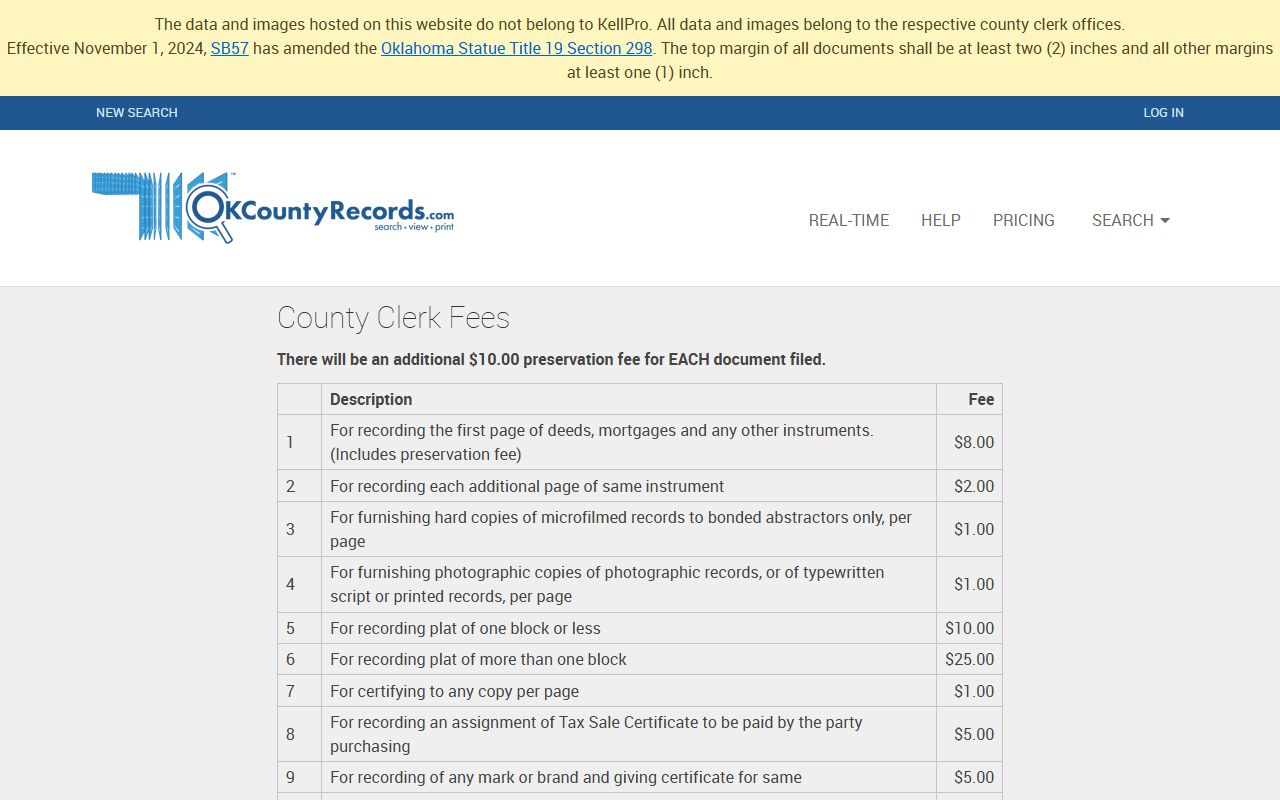
Those recording charges apply when a deed or affidavit moves estate property outside the court file, so they are useful to know alongside any probate filing fee.
The most common County Clerk charges that touch estate property are summarized below.
| Item | Amount |
|---|---|
| Recording, first page (conforming document) | $18 |
| Each additional page, same instrument | $2 |
| Recording, first page (nonconforming document) | $35 |
| Certified copy | $1 per certificate |
| Land record copy | $1 per page |
| Documentary stamp tax | $0.75 per $500 of value |
Steps in a Texas County Probate Case
An Oklahoma estate follows a set path from opening to closing. The exact route depends on whether there is a will, whether anyone contests it, and whether real estate is part of the estate.
- Decide whether probate is needed. Some small Oklahoma estate transfers use affidavits for qualifying property, but real estate and contested estates usually require a court case.
- File the will or petition. The will, petition, or guardianship pleading goes to the Court Clerk to open the case.
- Pay the filing fee. Pay the current district court fee, or ask the clerk about fee-waiver guidance if you qualify.
- Give required notice. The law requires notice to heirs, beneficiaries, creditors, and other interested people.
- Attend the hearings. The District Judge or Associate District Judge hears the matter on assigned dates.
- Collect the final documents. Letters, orders, certified copies, and the final decree all come from the Court Clerk.
Transferring Property Outside Probate in Texas County
Not every asset has to pass through a probate case. Oklahoma lets some property transfer through recorded documents that skip the estate docket entirely. The Texas County forms page lists two that come up often, the Transfer on Death Deed and the Affidavit of Surviving Joint Tenant, also known as AOC Form 20. Both download from the official Texas County forms page.
These are land instruments, not probate filings. They are recorded with the Texas County County Clerk, the office that handles deeds, mortgages, and liens, rather than the Court Clerk who keeps court case files. A transfer-on-death deed names who receives real estate when the owner dies, and the surviving-joint-tenant affidavit clears title after a co-owner passes away.
The duties and recording links for that office appear on the Texas County County Clerk page.
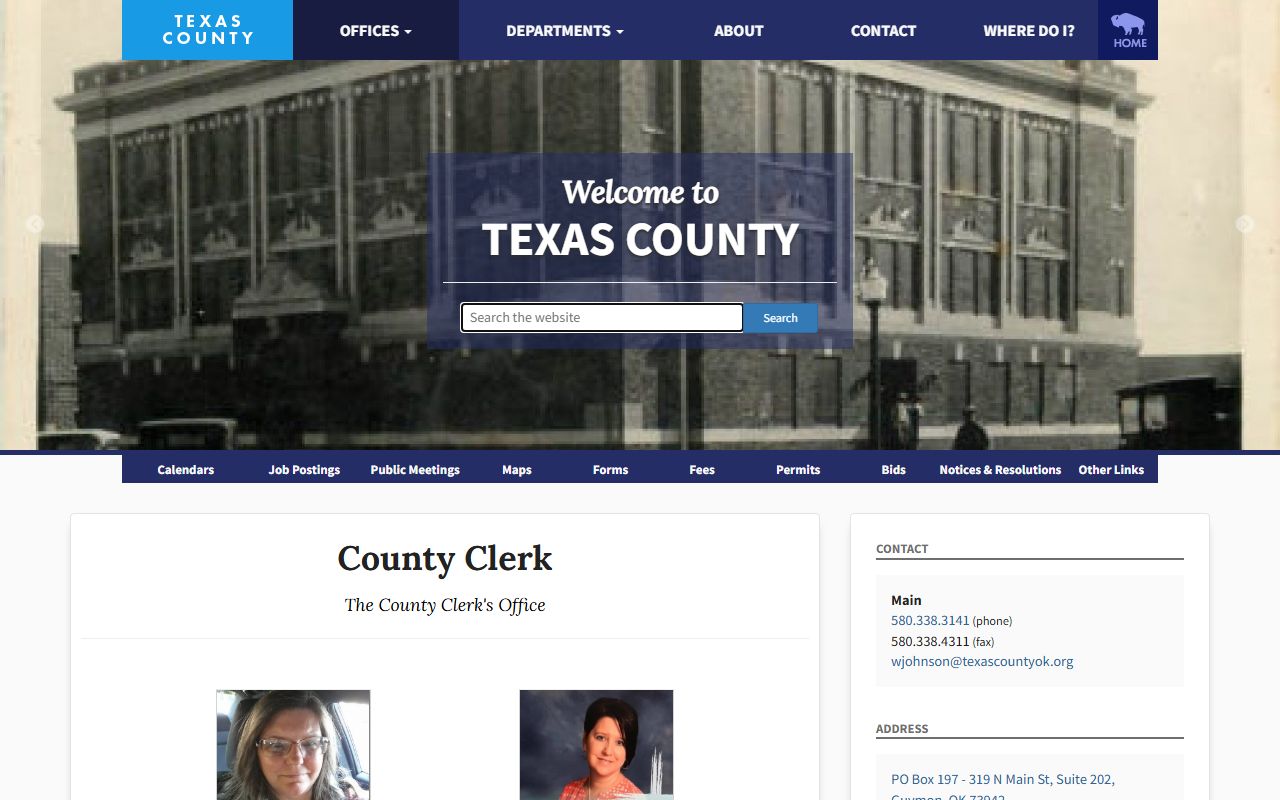
That office records the deed or affidavit, while any estate that still needs court oversight stays with the probate division. For deeds, liens, and the land-record portal in full detail, the Texas County County Clerk page explains how recording works.
What Texas County Probate Records Show
A probate file builds a paper trail of how an estate is handled. Once a case opens, the docket and file can include the will admitted by the court, the order appointing a personal representative, and the letters that give that person authority to act.
Beyond the opening papers, the file tracks the work of settling the estate. An inventory lists what the estate owns. Creditor notices and claims show what is owed. Accountings report money coming in and going out, and a final decree of distribution records who receives what before the case closes. Typical fields a searcher will see include:
- Decedent or ward name and the case number
- Personal representative, executor, or guardian
- Filing dates and scheduled hearings
- Will and the order admitting it to probate
- Inventory and appraisal of estate property
- Accountings and the final decree of distribution
Restricted Texas County Probate Records
Most estate files stay open to the public, but parts of the probate division carry privacy rules. Guardianship and conservatorship matters can involve medical and capacity information, so details may be sealed or limited. Records tied to minors, mental-health proceedings, and adoption are confidential under Oklahoma law and usually will not appear in a public docket.
A few other points trip up searchers. A will filed for safekeeping is not the same as an open estate case, so a deposited will may show little activity. If an online search comes up empty, the record may simply be older than the index, recently filed, or restricted by law.
A call to the Court Clerk settles most of these questions quickly. Family matters that often sit near an estate, such as a spouse's case, are covered separately under Texas County marriage and divorce records.