
About the Texas County Court Clerk
M. Renee Ellis serves as the Texas County Court Clerk. In Oklahoma the office is called the Court Clerk, not the Clerk of Court, and it is one of the county's elected offices. The clerk records, files, and preserves the permanent record of the District Court. That work touches almost every kind of case a person can bring in Guymon, from a small claims dispute to a felony charge.
The office answers to two bodies outside the county. It is accountable to the Oklahoma Court Administrator's Office and to the Oklahoma Supreme Court, which set the rules that govern how court records are kept and released. The clerk also serves as a certified Passport Acceptance Facility, so the counter handles federal passport applications alongside court business.
Texas County Court Clerk
Court Clerk: M. Renee Ellis
PO Box 1081
319 N Main St., Suite 301
Guymon, OK 73942
580-338-3003
renee.ellis@oscn.net
Hours: 8:00 a.m. to 5:00 p.m., open during the noon hour with limited staff
What the Texas County Court Clerk Does
The Court Clerk is the keeper of the court file. Every petition, motion, order, plea, and judgment in a District Court case lands with the clerk, who time-stamps it, indexes it, and stores it as part of the permanent record. The clerk also maintains the appearance docket, the running list of filings and events that shows how a case has moved from start to finish.
The office works across all of the District Court's divisions, so one counter serves a wide mix of cases. Its core duties include the following.
- Records, files, and keeps the permanent District Court record
- Works with the Civil, Criminal, Probate, Juvenile, Domestic Relations, and Small Claims divisions
- Maintains the appearance docket for each case filed
- Keeps filed court-reporter transcripts
- Issues marriage licenses and collects the license fee
- Collects court costs and deposits the funds into the court fund
- Serves as a certified Passport Acceptance Facility
The records the clerk keeps are the records of the District Court in Guymon, the court of general jurisdiction for the county. To see the bench those records flow from, the county lists its Texas County District Judge on its official site.
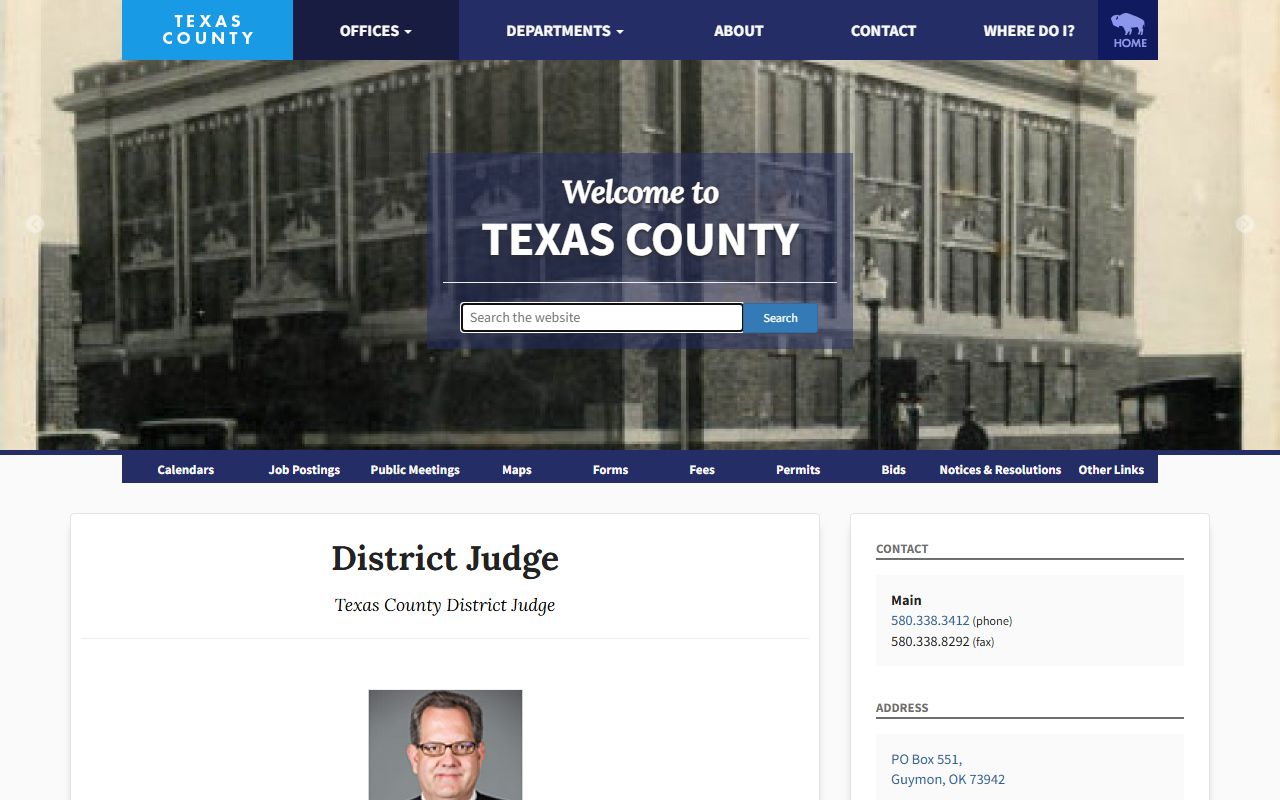
The District Judge and Associate District Judge hear the cases, and the Court Clerk holds the file that results, which is why the two offices work side by side in the courthouse.
Court Clerk vs County Clerk in Texas County
The single most common mix-up at the courthouse is the difference between the Court Clerk and the County Clerk. They sound alike and share the same building, but they keep entirely different records. The Court Clerk holds court case files. The County Clerk records land and property instruments. Sending a request to the wrong office is the fastest way to lose a day.
Use the Court Clerk for anything tied to a court case, and use the County Clerk for anything tied to real estate or recorded county documents.
| Question | Court Clerk | County Clerk |
|---|---|---|
| Who holds it | M. Renee Ellis, Suite 301 | Wendy Johnson, Suite 202 |
| What it keeps | Court case records: divorce, criminal, probate, civil, traffic, and warrant dockets | Land records: deeds, mortgages, liens, plats, and documentary stamps |
| Marriage licenses | Issues the license | Does not issue licenses |
| Online search | ODCR and OSCN dockets | County land-record portal |
For deeds, recorded liens, plats, and documentary-stamp filings, the right starting point is the Texas County County Clerk, the separate recording office.
Note: Both offices share the 319 North Main Street building, so confirm the suite number and the office name before mailing a request.
How to Request Texas County Court Records
The Court Clerk offers several ways to ask for a record. The right channel depends on whether you need a quick docket lookup or a stamped, official copy. Online docket systems are the fastest way to find a case, while the clerk's counter is the only source for certified copies.
Court records can be requested through any of these channels:
- In person at the Court Clerk's counter, Suite 301, during business hours
- By mail to PO Box 1081, Guymon, OK 73942
- By phone at 580-338-3003
- By email to renee.ellis@oscn.net
- Online through the docket systems for searching and reading case history
For online docket research, the county links the public to two statewide systems. On Demand Court Records lets you search by party name, case type, case number, and filed-date range for participating Oklahoma courts. The Oklahoma State Courts Network adds case-number search, separate last, first, and middle name fields, party-role filters, and a District Court citation search. Both show the docket and case history, but neither produces a certified copy. For a guided walk through searching, the Texas County court records page lays out the full process, and ongoing case activity is tracked in the county court dockets.
How to Request a Certified Copy
A certified copy is a clerk-authenticated copy that carries the office seal. Courts, agencies, and many private parties require a certified copy for official use, because a printout from a docket screen is not accepted as proof. Common needs include a certified divorce decree, a probate order, or a final judgment.
- Identify the case number. Look it up in ODCR or OSCN, or call the Court Clerk if you only have party names.
- Confirm the exact document and how many certified copies you need.
- Contact the Court Clerk in person, by phone, by mail, or by email to place the request.
- Pay the certification and copy fees by the method the office accepts.
- Pick up the copies in person, or provide a mailing address so the clerk can return them.
Note: Certified copies are required for legal proceedings, while an uncertified online printout is fine only for personal reference and will not stand in as an official record.
Texas County Records Request Fields
Whether you write, call, or visit, the Court Clerk needs the same core details to pull the right file. Having them ready before you contact the office speeds the request and cuts down on follow-up. The table below outlines a reasonable intake for a court-records request.
| Field | Required | Notes |
|---|---|---|
| Requester name | Yes | Your name and a way to reach you for questions or pickup. |
| Case number | No | Speeds the search; the prefix and year, such as FD or CF, help most. |
| Party names | Yes | Last, first for each party if the case number is unknown. |
| Record type | Yes | Decree, order, judgment, full file, or a specific filing. |
| Copy type | Yes | Plain copy or certified copy. |
| Delivery method | Yes | In-person pickup, mail, or email where allowed. |
| Payment | Yes | Confirm accepted methods and amount with the clerk before sending. |
Texas County Court Clerk Fees
Court fees in Oklahoma are not set at the county counter. The county fee page points court-related charges to the statewide Oklahoma Fee and Bond Schedules, so the exact amount for a filing or a certified copy should be confirmed with the Court Clerk before payment. The one rate the county publishes directly is the Open Records copy charge.
| Item | Amount |
|---|---|
| Open Records copy, per page | $0.25 |
| Certified copy fee | Set by the Oklahoma Fee and Bond Schedules; confirm with the Court Clerk |
| Court case filing fee | Set by the Oklahoma Fee and Bond Schedules; confirm with the Court Clerk |
| Marriage license fee | Confirm the current amount with the Court Clerk |
| Court costs | Collected by the clerk and deposited into the court fund |
The clerk collects these funds and deposits court costs into the court fund. Because amounts can change, a quick call to 580-338-3003 confirms the current charge before you mail money or visit.
Marriage Licenses From the Court Clerk
In Oklahoma the marriage license is a Court Clerk function, not a land-record function. Couples apply with the Texas County Court Clerk, who issues the license and collects the fee. The license then comes back to the same office after the ceremony to be recorded.
A few points shape the process. Oklahoma has no residency requirement for a license, but the marriage must be performed in the state. Both applicants bring proof of age and identity, such as a driver's license, certified birth certificate, or passport. After the ceremony, the completed license is returned to the Court Clerk, commonly within 30 days.
Note: A person divorced in Oklahoma generally may not marry someone other than the former spouse for six months after the decree is filed.
Public Access to Court Clerk Records
Oklahoma starts from a position of openness. Under the Oklahoma Open Records Act, found at 51 O.S. § 24A.1 and following, the public may inspect and copy the records of a public body unless a specific law makes a record confidential. Most District Court case files held by the Court Clerk are open on that basis.
Some categories are restricted. Juvenile cases, adoption files, mental-health proceedings, and sealed or expunged records are limited or closed, and personal identifiers like Social Security numbers and minor children's names may be redacted. When a file is not online, that absence does not prove a case never existed, so the clerk's counter remains the authority. Older matters, recently filed cases, and protected records may simply not appear in a docket search.
Federal Records Outside the Court Clerk
The Court Clerk keeps the county's District Court record, but federal cases are a different track entirely. A federal criminal charge, a federal civil suit, or a bankruptcy filing from Texas County is handled by a federal court clerk, not the county office. Knowing the line helps when a search of the county docket turns up nothing.
Bankruptcy is one clear example. Debt and creditor proceedings for this region run through the federal bankruptcy court rather than the county courthouse, and that court keeps its own clerk and record.
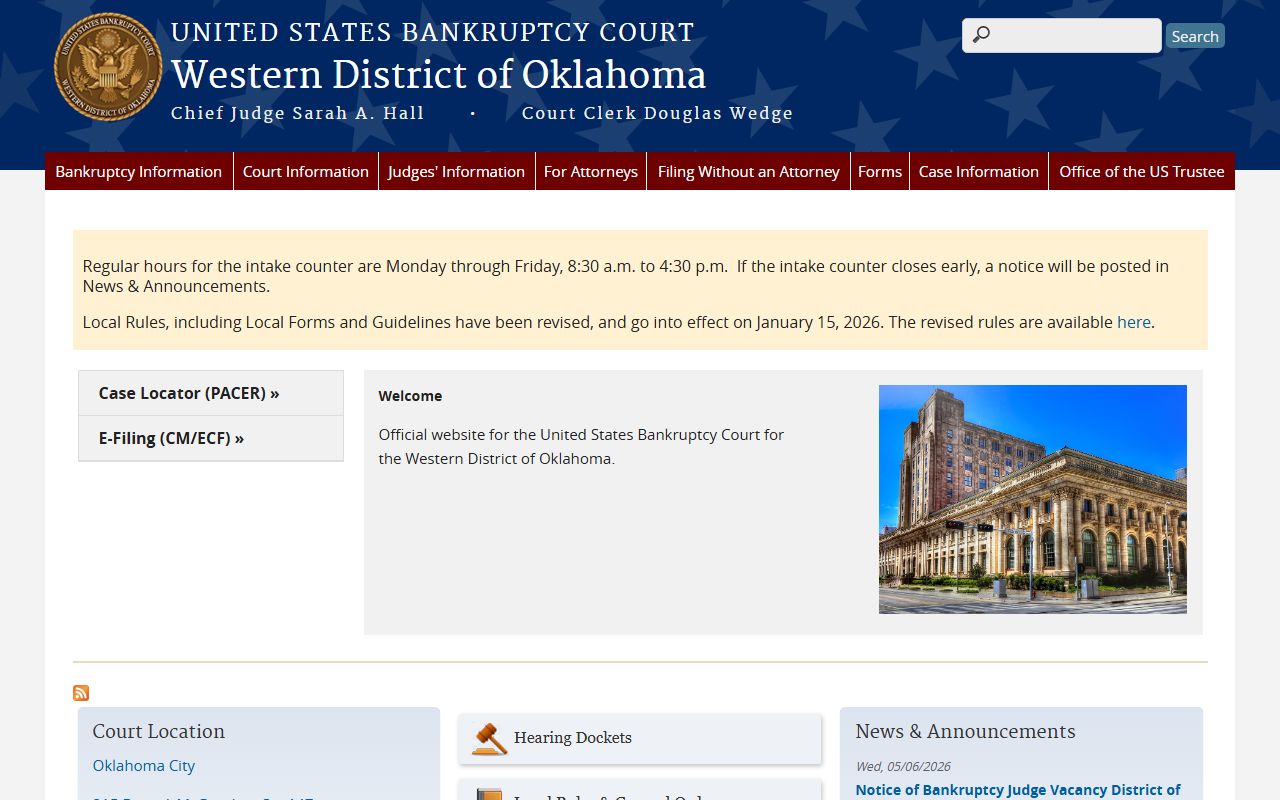
The U.S. Bankruptcy Court for the Western District of Oklahoma maintains those files, which are federal records and not county probate or civil cases held by the Court Clerk.
Federal criminal and civil matters follow the same pattern. They are filed with the federal district court clerk, who is reached through a separate office with its own contacts and hours.
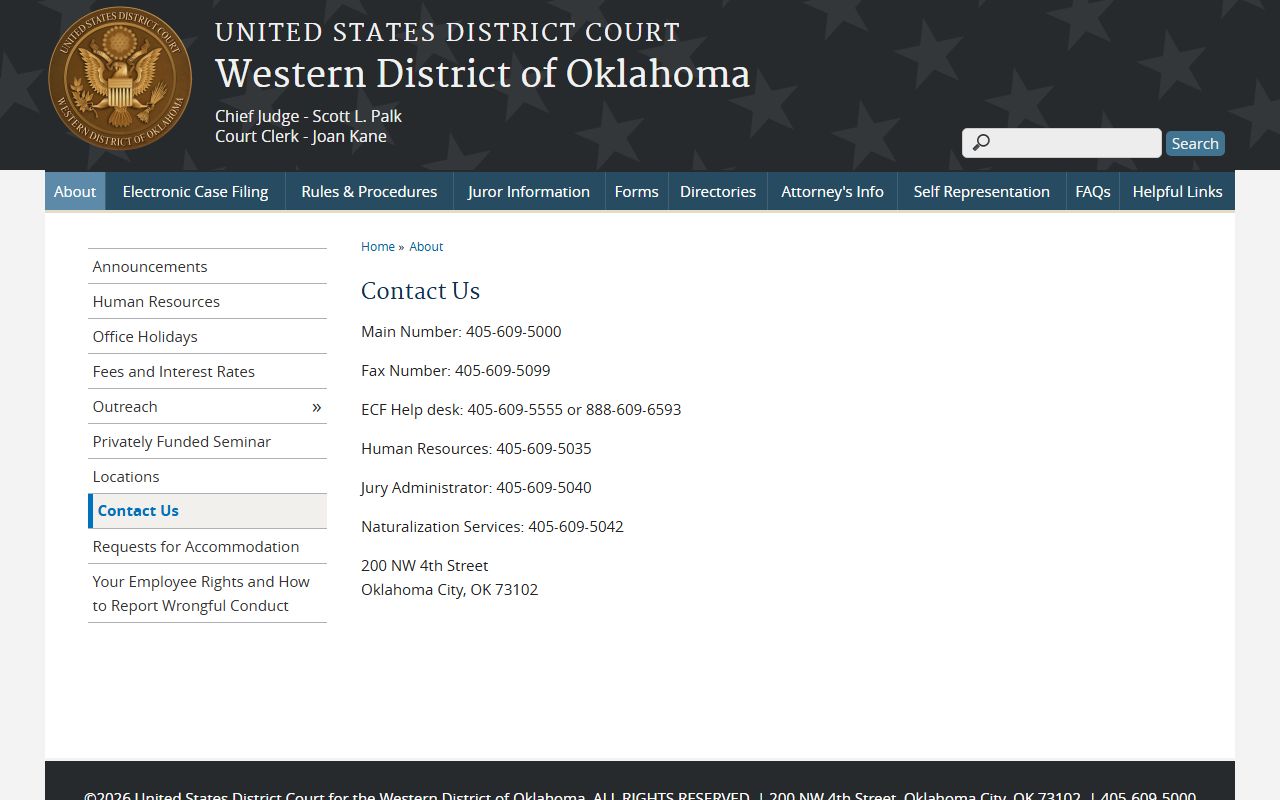
The U.S. District Court for the Western District of Oklahoma lists its clerk contacts and office locations, which is where a federal case from the county would be filed rather than at the Court Clerk's counter in Guymon.