
Criminal Court Records in Texas County
A criminal court record is the case file opened when the State formally accuses someone of a crime. In Texas County, the Court Clerk records, files, and keeps these permanent District Court records. The clerk maintains an appearance docket for each case, holds filed court-reporter transcripts, and works with the criminal division of the court. The file is broader than a single charge. It follows the matter from the charging document through bond, plea, motions, hearings, disposition, sentence, and any appeal. A charge listing alone is not the whole story, so the docket should be read in full before drawing any conclusion about an outcome.
Texas County criminal cases are heard in the District Court, the state trial court of general jurisdiction. The District Court handles both felony prosecutions and misdemeanors. Felony case numbers carry the CF prefix, and misdemeanors carry CM. Guymon Municipal Court is a separate limited court for city ordinance and municipal criminal offenses, so those matters do not appear in the District Court file. Criminal appeals do not go to the civil high court. They are heard by the Oklahoma Court of Criminal Appeals, which is one of the state's two courts of last resort.
How to Search Texas County Criminal Court Records
Two statewide systems carry District Court criminal cases. On Demand Court Records (ODCR) is the system Texas County links as its District Court Records source, and it lets the public search by court, party name, case type, and filed date. The Oklahoma State Courts Network (OSCN) also lists Texas County District Court and supports case-number, party, date, and District Court citation searches. Either tool is a starting point, not a replacement for the clerk's certified file.
- Open ODCR or OSCN and select Texas County District Court from the court list.
- Search by defendant name in Last, First form, or enter the full case number if you have it.
- Narrow by case type, choosing Criminal Felony (CF) or Criminal Misdemeanor (CM), and add a filed-date range when a name is common.
- Open the case and read the docket through to the disposition and sentence, not just the opening charge.
- Request a certified copy from the Court Clerk at 580-338-3003 when you need a copy that an agency or court will accept.
For city-level criminal and traffic citations, Guymon Municipal Court keeps its own records apart from the District Court. For a statewide criminal history that pulls together cases from more than one county, the OSBI criminal history portal is the right channel. The closer look at the charges themselves lives in the Texas County court charge records.
Stages of a Texas County Criminal Case
A criminal case moves through set stages, and each one leaves an entry in the court file. Reading the docket in order shows where a case stands today and how it got there. The path runs from the charging document to the final sentence, with motions and hearings filling the time between.
Case flow: Charges Filed › Arraignment › Pretrial / Motions › Plea or Trial › Disposition › Sentencing
- Charges Filed. The District Attorney files an information or complaint, and the clerk opens the case under a CF or CM number.
- Arraignment. The defendant hears the charges in open court, enters a first plea, and the court addresses bond and counsel.
- Pretrial and Motions. Lawyers file written requests, exchange evidence, and argue motions, and the docket logs each filing, order, and continuance.
- Plea or Trial. The case ends in a negotiated plea or proceeds to trial before a judge or jury, where guilt is tested beyond a reasonable doubt.
- Disposition. The record shows the outcome of each count, such as a guilty plea, dismissal, acquittal, or deferred judgment.
- Sentencing. The court sets the penalty, which may include prison, jail, probation, fines, costs, or restitution.
What a Texas County Criminal Court Record Shows
The criminal case file gathers many fields in one place. A docket entry can record a filing, a hearing, an order, or a payment, and the case summary pulls the key facts to the top. The table below lists the fields a Texas County criminal record commonly displays and what each one tells a reader.
| Field | What It Shows |
|---|---|
| Case Number | The prefix, year, and number, such as a CF felony or CM misdemeanor case opened by the Court Clerk. |
| Defendant | The accused party, plus the State of Oklahoma as the prosecuting party and any listed attorneys. |
| Charges | Each count by statute and offense, with the count number and offense date as filed by the District Attorney. |
| Bond | The amount set, the type, and any bondsman or surety tied to release. |
| Plea | The defendant's answer to each count, such as guilty, not guilty, or no contest (nolo contendere). |
| Disposition | The result of each count, including dismissal, acquittal, conviction, or a deferred judgment. |
| Sentence | The penalty ordered, such as confinement, probation, fines, court costs, or restitution to a victim. |
Some fields stay out of public view. Court rules and e-filing notices direct filers to protect Social Security numbers, dates of birth, financial-account numbers, home addresses, and the names of minor children, so those identifiers may be redacted in what the public sees.
Charges vs. Convictions
Being charged is not the same as being convicted. A criminal court record can show counts that were later dropped, dismissed, reduced, or that ended in an acquittal at trial. A charge is an accusation that a case may proceed. A conviction is a final finding of guilt by plea or verdict. Reading the disposition for each count is the only way to tell which one applies.
| Charge | Conviction | |
|---|---|---|
| Stage | Accusation at filing | Final verdict or plea |
| Burden of Proof | Probable cause | Beyond a reasonable doubt |
| Outcome Possible | Dismissed, reduced, or tried | Sentence imposed |
| Public Record | Yes | Yes |
This distinction matters for anyone reading a record for hiring, housing, or personal reasons. A dismissed felony count and a felony conviction look very different in the docket once the disposition is read, even when the charge text is the same.
Reading Texas County Criminal Dispositions
The disposition is the current or final outcome of a charge. Common entries include guilty, not guilty, dismissed, and no contest. A deferred judgment is its own outcome, where the court delays a finding of guilt while the defendant completes conditions, and the case may be dismissed at the end of the term. A no contest plea accepts the conviction without admitting the underlying facts the same way a guilty plea does.
The sentence sits next to the disposition in the file. It can list time to serve, a suspended term, probation, fines, court costs, and restitution ordered to a victim. The docket may also log payment activity and a warrant for failure to pay. Because abbreviations vary, the safest reading uses the full docket entries and, when an official copy is needed, a certified copy from the Court Clerk rather than a screenshot.
Who Files Texas County Criminal Charges
A criminal case does not open because of an arrest alone. It opens when the District Attorney decides to file. Texas County sits in District 1, which the Office of the District Attorney serves along with Cimarron, Beaver, and Harper Counties. District Attorney George H. Leach III leads that office, described by the county as the chief law enforcement officer for the district. The prosecutor reviews the police submission, decides which counts to bring, and files the information that starts the District Court case.
The official Oklahoma District Attorneys Council page for the district lists the office and its functions, including payment categories for diversion and restitution. The screenshot below comes from the District Attorneys Council District 1 page.
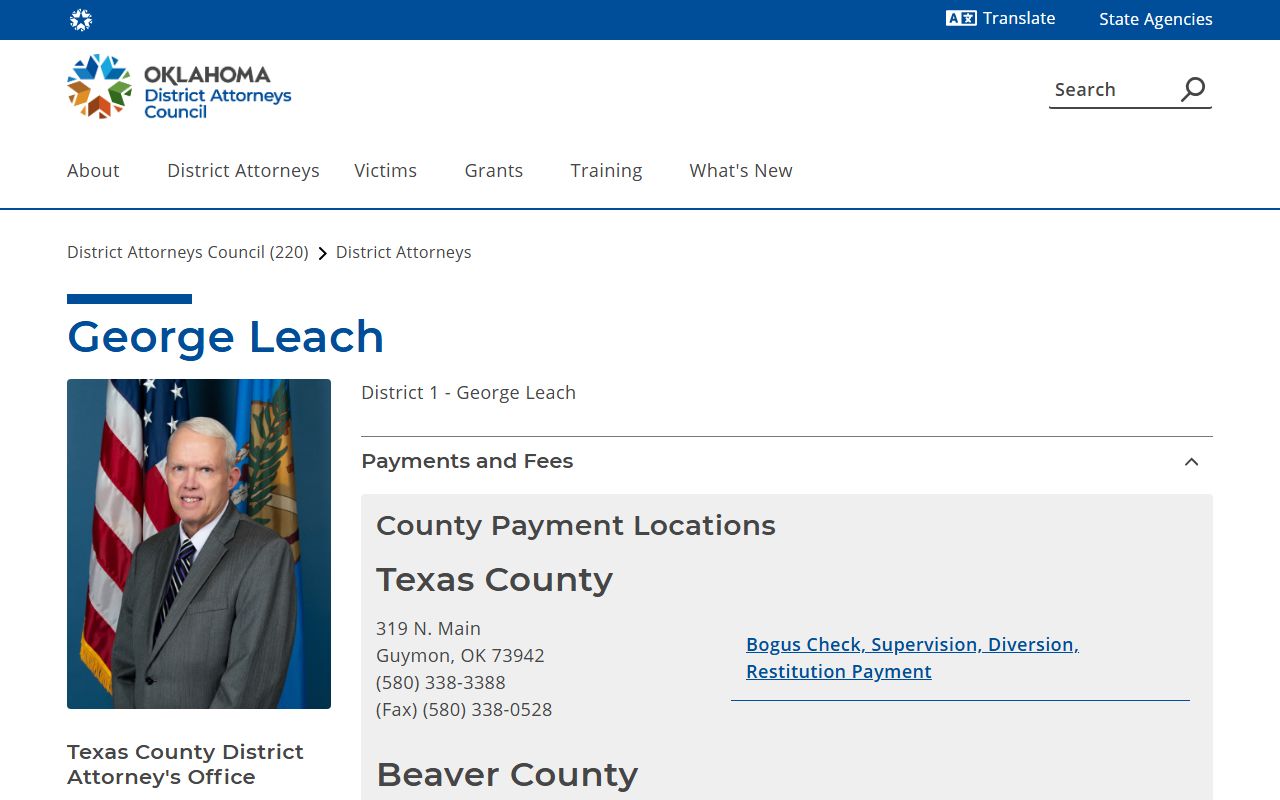
That filing decision shapes the entire record. The counts the prosecutor selects become the charges on the docket, and later amendments, reductions, or dismissals also flow from the District Attorney's office. A defendant who cannot afford a lawyer asks the District Court for appointed counsel, and that request is handled through the assigned judge and the Court Clerk.
Statewide Criminal History vs. the Court File
The Texas County case file is one court's record of one case. A statewide criminal history is a different document. The Oklahoma State Bureau of Investigation runs the Criminal History Information Request Portal, known as CHIRP, where the public can request an Oklahoma criminal history report. That report can pull together arrests and dispositions from across the state, which a single county docket cannot do.
The CHIRP portal is a request system, not a live warrant or jail search. Requests start at the OSBI CHIRP portal, shown below.
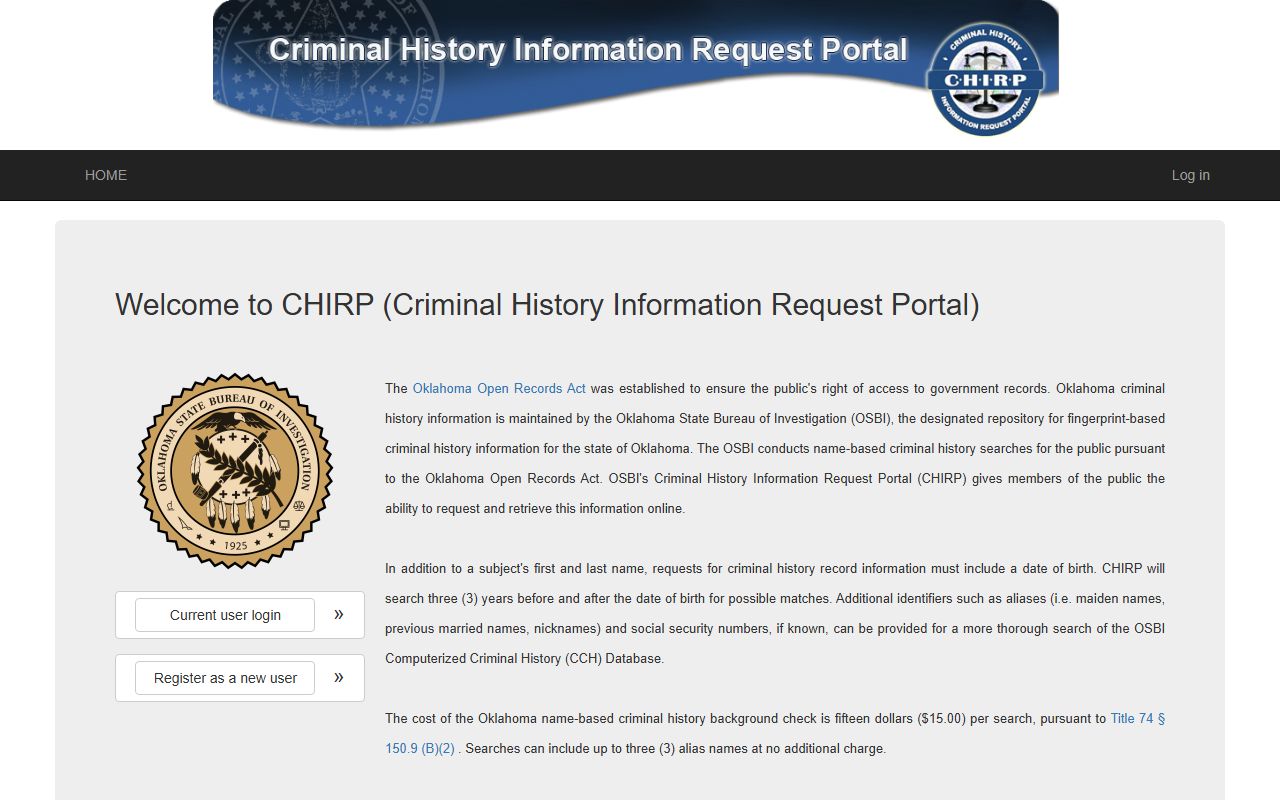
Use both sources for different jobs. The District Court docket on ODCR or OSCN is best for reading one case in full, including motions and the sentence. The OSBI report is best for a broader background check across counties. For the day-to-day record of all county court matters beyond criminal cases, the Texas County court records page covers civil, family, probate, and traffic files too.
Sealed vs. Expunged Records
Two terms get mixed up often. A sealed record is hidden from ordinary public access by law or court order, though some agencies keep limited access. An expunged record is treated as though it never existed for most purposes, with access removed or destroyed. Both remove a case from easy public view, but the legal effect is not the same.
| Sealed | Expunged | |
|---|---|---|
| Visibility | Hidden from the public | Treated as never having existed |
| Law Enforcement | Limited access retained | Very limited access |
| Eligibility | By statute or court order under Oklahoma law | Categories set by 22 O.S. § 18(A) |
| How It Starts | Court order in the case | Petition filed with the District Court |
An expungement in Texas County starts with eligibility, not with a clerk deleting a record on request. The Oklahoma State Bureau of Investigation states plainly that it cannot pre-approve a person and points applicants to the categories in 22 O.S. § 18(A).
- Identify the arrest or case number, the disposition, the date, and the agency that holds the record.
- Check the eligibility categories in 22 O.S. § 18(A) using the OSBI expungement page.
- File the proper petition or motion in the District Court tied to the case, usually the court where the case was heard.
- Give notice to required agencies so they can object or comply.
- If the judge grants relief, serve the order on the Court Clerk, law enforcement, OSBI, and any jail or sheriff records that hold the file.
Note: Expungement is not the same as a pardon, a dismissal, or a deferred sentence, and the exact effect depends on the statute and the court's order.
Public Access to Texas County Criminal Court Records
Oklahoma law treats most court records as open. The Open Records Act supports inspection and copying of public records unless another law makes a record confidential. Court orders can still restrict access to specific pleadings or files, and certain case types are protected from the start. The two statutes below frame how the criminal case file reaches the public.
Key Statutes:
Oklahoma Open Records Act, 51 O.S. § 24A.1 et seq. - public body records are open for inspection and copying unless a specific law makes them confidential.
22 O.S. § 18 - sets the categories under which a qualifying criminal record may be expunged, with OSBI noting it cannot pre-approve eligibility.
In practice, the first question is which office owns the record. Criminal case files, dockets, and dispositions belong with the Court Clerk. Online searches through ODCR and OSCN are convenient, but they do not replace the certified record from the clerk's counter.
Texas County Criminal Appeals
When a Texas County defendant challenges a conviction or sentence, the appeal does not go to the civil high court. Oklahoma splits its appeals by subject. Criminal appeals are heard by the Oklahoma Court of Criminal Appeals, one of the state's two courts of last resort. The trial record built in the District Court becomes the foundation for that review.
The appellate court publishes its rules and case information, and its public site explains how appeals are filed. The image below is from the Oklahoma Court of Criminal Appeals site.
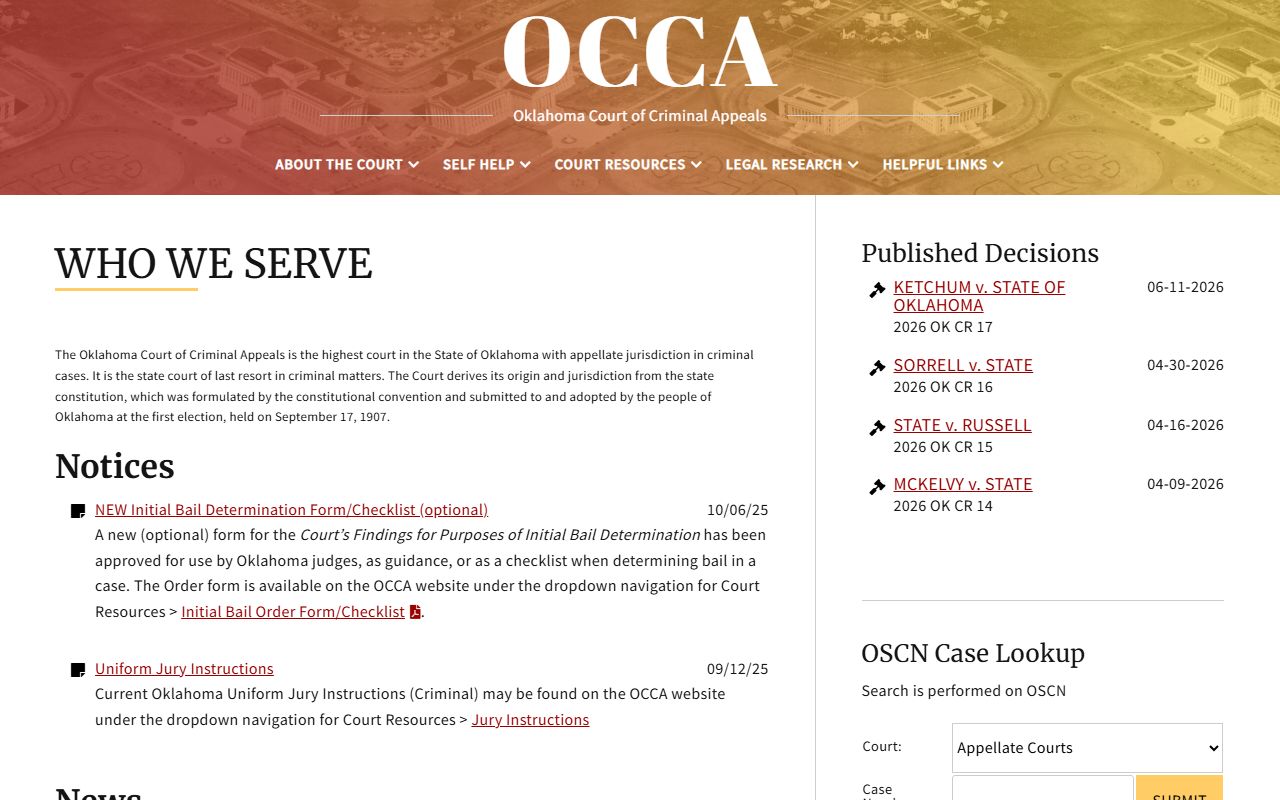
An appeal adds new entries to the case history, such as a notice of appeal and the appellate case number. The District Court file still holds the original charges, plea, disposition, and sentence, so a full reading often means checking both the trial docket and the appellate record.
Restricted Criminal Court Records in Texas County
Some criminal matters are kept out of public view. Juvenile records are generally confidential under Oklahoma law, and 10A O.S. § 1-6-102 lists juvenile records that are not open to the general public. Sealed and expunged cases are removed or limited once a court grants that relief. Ongoing investigations and sealed warrants may not appear until they are served.
If a case does not show up in an online search, that does not prove no case exists. Older files, recently filed matters, and protected categories may not appear in ODCR or OSCN. The Court Clerk records counter is the place to confirm, and certified copies for any legal use come from that office rather than a printout. Warrants tied to a criminal case, such as a bench warrant for a missed hearing, also surface in the docket and can be confirmed with the Court Clerk or the Sheriff's Office.