
Texas County Arrest Records and Court Charges
A Texas County arrest record is the law enforcement account of an arrest. It can show the arresting agency, the date and place of the arrest, the booking event, and the offense an officer first listed. The Texas County Sheriff and local police make arrests across the county. The case does not stop there. The District Attorney reviews what officers submit and decides which formal charges to file. Once those charges reach the Texas County Court Clerk, they open a court case and become the charge record. Current District Attorney George H. Leach III leads District 1, which covers Texas, Cimarron, Beaver, and Harper Counties.
The arrest record and the court charge record answer different questions. The arrest side tells you that someone was booked and held. Booking and jail custody detail belong to the Sheriff, and custody status is tracked on the inmate records page rather than in the court docket. The charge record tells you what the prosecutor actually filed and how those counts moved through the system. Court charges after arrest can grow, shrink, or disappear before trial. The complete case file, with pleas, hearings, and the final sentence, lives with the criminal case rather than the charge sheet alone.
How to Find Texas County Arrest Records and Charges
Filed charges show up in the Oklahoma court systems that publish Texas County District Court dockets. On Demand Court Records, known as ODCR, is the search the county links for District Court records. The Oklahoma State Courts Network, or OSCN, also lists Texas County District Court in its statewide docket search. Both let the public search by name or case number, and basic docket viewing is free. Arrest and raw booking detail is not in these dockets. To learn who is in custody, use the Sheriff or a statewide custody tool instead.
- Open ODCR or the OSCN search form and choose Texas County District Court.
- Search by the defendant's name in Last, First format, or enter the full case number if you already have it.
- Open the case and read the charge list, which shows each count, the statute cited, and the offense date.
- Check the status beside each charge to see whether it is pending, amended, reduced, dismissed, or resolved.
A court docket is not a criminal history report. For a statewide record that pulls charges from many counties into one file, the Oklahoma State Bureau of Investigation runs a request portal called CHIRP, covered further below.
How Texas County Charges Get Filed After an Arrest
The charge record begins when the District Attorney files a charging document with the court. An arrest alone does not create a charge. In Oklahoma, prosecutors use three main charging instruments. The one chosen depends on the offense level and how the case reaches the court.
| Complaint | Information | Indictment | |
|---|---|---|---|
| Filed By | Officer / Prosecutor | Prosecutor | Grand Jury |
| Common For | Misdemeanors | Many felonies | Serious felonies |
| Starts | The case | The case | The case |
The District Attorney's Office for District 1 makes the filing decision for Texas County. The county describes the District Attorney as the chief law enforcement officer for the district. A booking charge listed at the jail is not final. After review, the prosecutor can file the same charge, change it, add counts, reduce it, or decline to file at all. The office also sets bond positions and handles the initial appearance once a charge is on file.
The Texas County District Attorney page names the prosecutors who review arrests and file charges across the four-county district.

That same office decides whether the booking offense becomes a formal felony or misdemeanor count in the District Court file. Its contact details are listed below.
Office of the District Attorney, District 1
319 N Main, Guymon, OK 73942
580-338-3388
Hours 8:30 a.m. to 5:00 p.m., closed noon to 1:00
State office reference: Oklahoma District Attorneys Council, District 1.
Charge Status in Texas County Court Records
Charges are not fixed once filed. As a case moves, the prosecutor or the court can change the counts. Reading the status beside each charge tells you where that count stands right now. The terms below appear in Texas County District Court dockets and in the statewide systems.
| Status | What It Means |
|---|---|
| Filed | The prosecutor has formally charged the count, and the case is open and pending. |
| Amended | The charge wording, statute, or count has been changed since it was first filed. |
| Reduced | The charge has been lowered to a less serious level, such as a felony dropped to a misdemeanor. |
| Dismissed | The court has ended the charge, so it is no longer being pursued in that case. |
| Nolle Prosequi | The prosecutor has chosen not to proceed on the charge and has withdrawn it. |
Note: A jail booking charge can be declined, amended, or dismissed once the District Attorney reviews the case, so an early charge may not match the final filing.
Charges vs. Convictions in Texas County
Being charged is not the same as being convicted. A charge is an accusation a prosecutor still has to prove. A conviction is the result after a plea or a verdict. A Texas County charge record can show open counts that never end in a conviction, so a reader should never treat a filed charge as proof of guilt.
| Charge | Conviction | |
|---|---|---|
| Stage | Accusation | Verdict or plea |
| Burden of Proof | Probable cause | Beyond reasonable doubt |
| Public Record | Yes | Yes |
The plea, verdict, disposition, and any sentence sit in the full case file. For that level of detail, the criminal court records page follows a case from charge through final outcome.
Texas County Charge Codes and Severity Levels
Each charge ties to a specific Oklahoma statute and carries a severity level. Felonies are the most serious, misdemeanors are lower level, and one arrest can produce several separate counts. Texas County case numbers carry a prefix that signals the charge type, so the prefix is often the fastest way to read a docket result.
- CF: Criminal Felony, the most serious state charges.
- CM: Criminal Misdemeanor, lower-level offenses.
- CP: Criminal Probable Cause matters.
- SW: Search Warrant case type.
- TR: Traffic cases filed in District Court.
A single booking can split into more than one count, and the counts may carry different prefixes. Felony filings appear under CF, while a connected lesser offense from the same arrest may post as CM. The statute cited next to each count is the legal basis for that charge. Reading the statute, not just the label, tells you what the state must prove.
Statewide Criminal History Lookups for Texas County
Court dockets cover one county at a time. For a statewide record, the Oklahoma State Bureau of Investigation operates the Criminal History Information Request Portal, known as CHIRP. A CHIRP report compiles arrest and charge data reported to the state from across Oklahoma. It is a request service, not a live docket, and it follows OSBI rules on who may receive certain results.
A CHIRP report and a Texas County court docket are not interchangeable. The docket shows the day-to-day filings in one case. The CHIRP report rolls reported charges into a single statewide history. For a certified copy of a specific case, the Texas County Court Clerk at 580-338-3003 remains the official source.
Federal Charges in Texas County
Not every charge filed against a Texas County resident is a state charge. Federal crimes are prosecuted by the United States Attorney's Office for the Western District of Oklahoma, which covers Texas County. Federal charges follow a separate path through the federal court system rather than the District Court in Guymon.
The U.S. Attorney's Office for the Western District of Oklahoma announces federal charges and prosecutions for the district.
Federal matters are tracked in the federal system, not in the county charge record, so an ODCR or OSCN search will not show them.
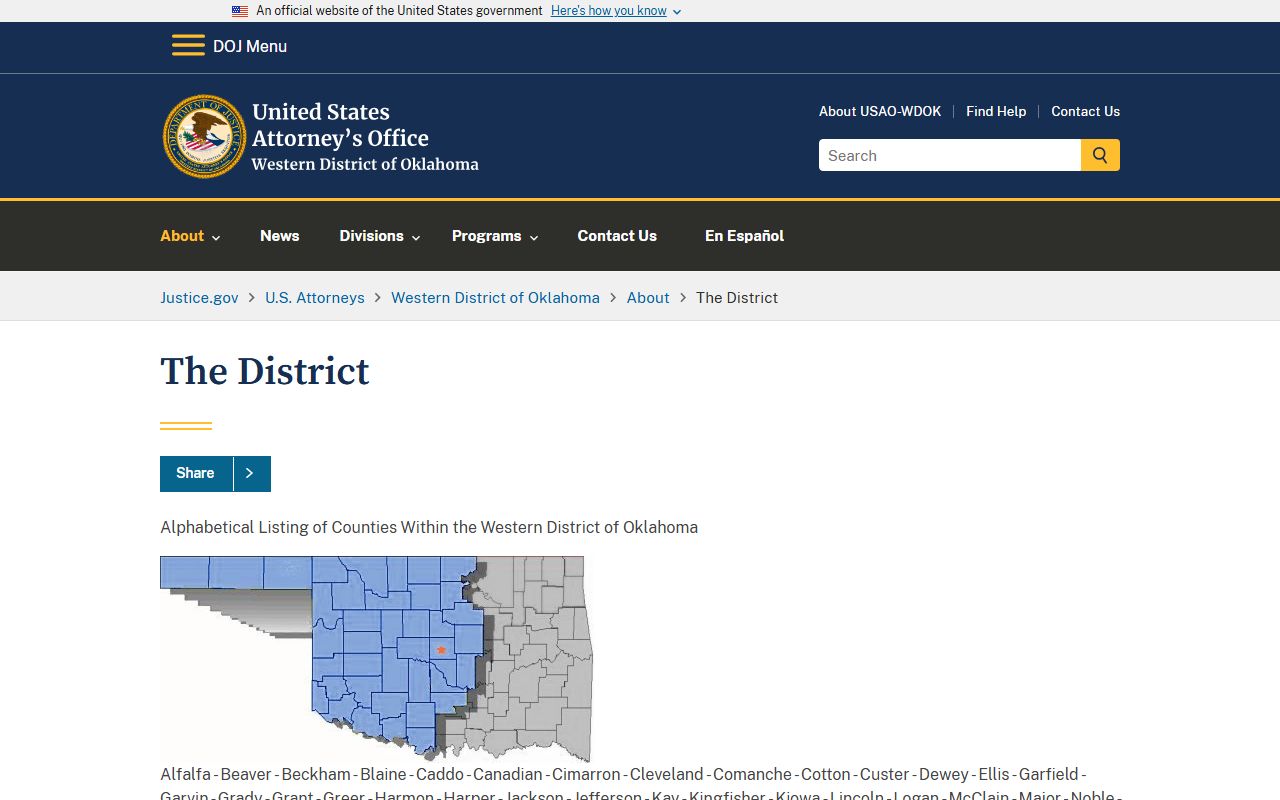
The district's reach is set county by county. The Western District county list confirms that Texas County sits inside the federal Western District of Oklahoma.
Knowing the venue matters. A federal charge will sit in the federal record, while a state charge from the same county sits with the Texas County District Court.
Sealed and Expunged Charge Records
Some charge records are removed from public view. Oklahoma allows qualifying records to be sealed or expunged, and the two are not the same thing. Eligibility comes from state law, and a court must order the relief. OSBI cannot pre-approve a person, and a clerk does not erase a record on request.
| Sealed | Expunged | |
|---|---|---|
| Visibility | Hidden from public | Treated as if it never existed |
| Law Enforcement | Limited access | Very limited access |
| Eligibility | Set by 22 O.S. § 18 categories | Set by 22 O.S. § 18 categories |
The state explains the process on the OSBI expungement page, which points to the categories in Title 22. A person should confirm the arrest or case number and disposition first, then file the proper petition in the court with jurisdiction.
Background Check Considerations
People often look up charges for tenant screening, hiring, or personal safety. Those uses can fall under the federal Fair Credit Reporting Act, which sets rules for regulated background checks. A casual docket search is different from an FCRA-compliant report, and the rules matter when a decision affects someone's job or housing.
Important: This site is not a consumer reporting agency under the FCRA, and its information cannot be used for employment, tenant, credit, or insurance screening decisions.
Restricted Charge Records in Texas County
Some Texas County charge records stay off the public docket entirely. Juvenile charges are generally confidential under Oklahoma law. Sealed and expunged cases drop out of ordinary public access. Adoption and mental health matters are restricted because they involve protected information. Personal identifiers such as Social Security numbers, dates of birth, and addresses are redacted under court rules.
An ongoing investigation can also keep details out of view until charges are filed. If the online portal does not show a case, that does not prove no case exists. For older, sealed, or missing records, the Texas County Court Clerk records counter is the right next step rather than a third-party site. The clerk can confirm whether a record is held, restricted, or simply not yet posted online, and certified copies always come from that office rather than from a screenshot.